How Long Fiber Thermoplastics (LFTs) help drone manufacturers produce lightweight, durable, impact-resistant rotor blades with superior fatigue performance and manufacturing efficiency.
- Home
- Composites
- Resources
- How LFTs Are Transforming Drone Propeller Manufacturing
How LFTs Are Transforming Drone Propeller Manufacturing
The Future of Drone Performance Starts with Better Materials
The global drone industry is evolving at an unprecedented pace. From commercial delivery drones and agricultural UAVs to defense surveillance systems and industrial inspection platforms, manufacturers are under constant pressure to build drones that fly longer, carry heavier payloads, and operate reliably in demanding environments.
One component has a particularly significant influence on overall drone performance—the rotor blade or propeller blade.
Rotor blades must be lightweight enough to maximize flight efficiency while remaining stiff, durable, and resistant to fatigue under thousands of high-speed rotations. Traditionally, manufacturers have relied on aluminum, carbon fiber laminates, or injection-molded plastics. However, these materials often involve compromises in cost, manufacturability, durability, or recyclability.
This is where Long Fiber Thermoplastics (LFTs) are emerging as a next-generation material solution.
By combining long reinforcing fibers with high-performance thermoplastic matrices, LFTs provide an exceptional balance of lightweight construction, mechanical strength, impact resistance, and manufacturing efficiency, making them increasingly attractive for advanced drone applications. Skyi’s Long Fiber Thermoplastics are engineered to deliver superior strength-to-weight ratios, excellent durability, and processing advantages across demanding structural applications.
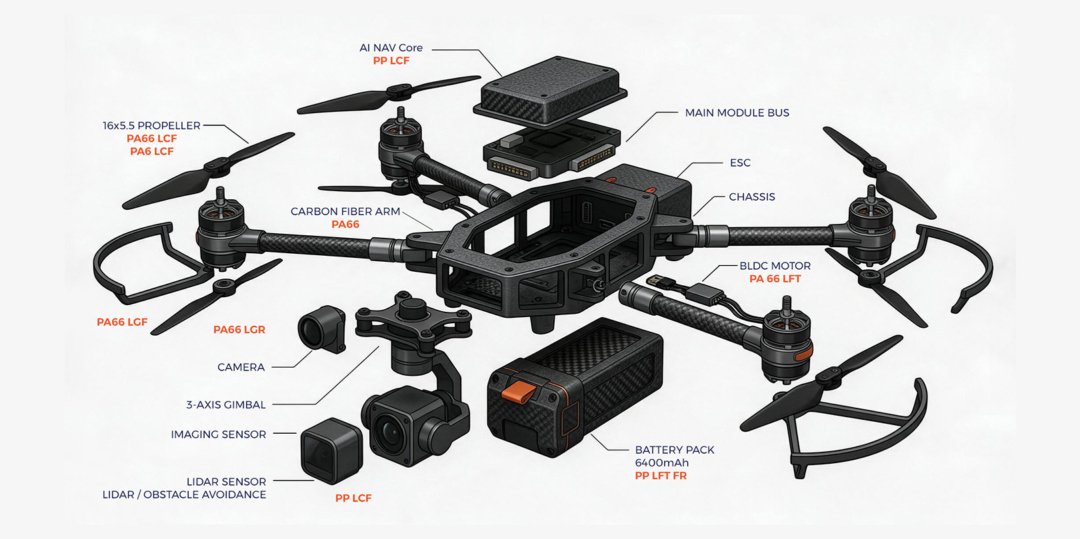
Why Rotor Blade Material Selection Matters
Every gram of weight added to a drone affects:
• Flight duration
• Payload capacity
• Energy consumption
• Motor efficiency
• Battery size
• Flight stability
At the same time, rotor blades experience:
• Continuous centrifugal loading
• Aerodynamic bending forces
• Cyclic fatigue
• Vibration
• Impact from debris or accidental landings
• UV exposure and varying weather conditions
The ideal rotor blade material must therefore combine:
• High stiffness for varying thinner wall design
• Low weight
• Excellent fatigue resistance
• Dimensional stability
• Weather resistance
• Cost-effective manufacturing
Meeting all these requirements simultaneously is challenging using conventional materials.

What Makes Long Fiber Thermoplastics Different?
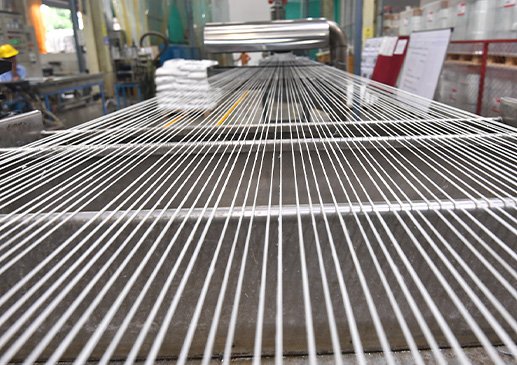
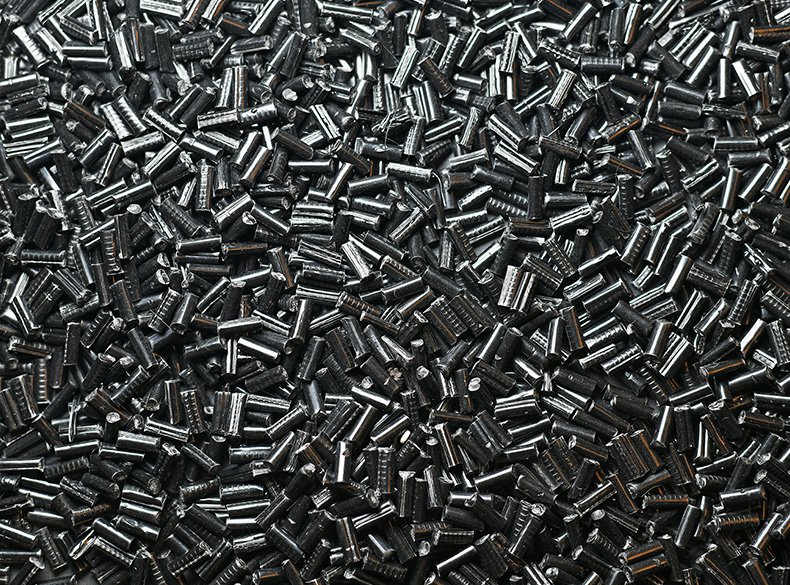
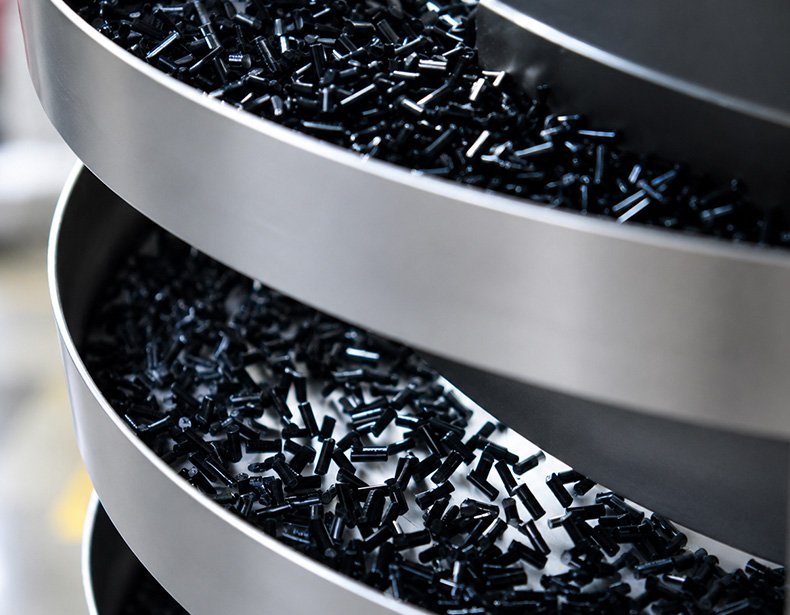
Long Fiber Thermoplastics consist of reinforcing fibers—typically glass or carbon fibers approximately 10–12 mm long—embedded within an engineered thermoplastic matrix such as polypropylene (PP), polyamide (PA), PET, or PBT.
Unlike short-fiber composites with chopped fibers less than 1 mm, Long Fiber Thermoplastics (LFTs) create a more continuous load-bearing network within the polymer matrix. This internal reinforcement structure improves stress transfer throughout the component and enhances key mechanical properties, including:
• Uniform mechanical performance (Isotropic behaviour)
• Higher tensile strength
• Improved impact resistance
• Longer fatigue life
• Better energy absorption
• Greater structural rigidity
• Enhanced creep resistance
During injection molding, the longer fibers form a three-dimensional reinforcement network that distributes loads more effectively than conventional short-fiber materials. This is especially valuable in thin or highly stressed blade sections, such as the rotor blade tip, where maintaining strength and stability is critical.
Advantages of LFTs for Drone Rotor Blades
1. Exceptional Strength-to-Weight Ratio
Weight reduction is one of the most effective ways to improve drone efficiency.
LFT rotor blades can significantly reduce component weight while maintaining the structural stiffness required for high-speed rotation. Lower blade mass reduces rotational inertia, allowing motors to accelerate and decelerate more efficiently, improving responsiveness and reducing energy consumption. The result is:
• Longer flight time
• Higher payload capacity
• Improved maneuverability
• Better battery efficiency
2. Superior Fatigue Resistance
Rotor blades rotate thousands of times every minute.
This continuous cyclic loading eventually causes fatigue damage in many conventional materials.
Long fibers help distribute stresses throughout the component, reducing localized crack formation and extending service life. Their excellent crack resistance makes LFTs particularly suitable for drones that operate for extended hours or in mission-critical applications. LFTs are widely used in structural applications where high strength, toughness, and durability are required.
3. Improved Impact Resistance
Drone operations often expose rotor blades to:
• Tree branches
• Sand particles
• Small stones
• Hard landings
• Transportation damage
Unlike brittle materials that can crack suddenly, LFTs exhibit excellent impact toughness by absorbing and dissipating energy through the long-fiber network.
This increases reliability while reducing maintenance costs.
4. Excellent Dimensional Stability
Rotor blade geometry has a direct impact on overall drone performance. It influences:
• Lift generation
• Flight efficiency
• Noise levels, particularly those caused by tip flutter
• Vibration during operation
LFTs help maintain dimensional accuracy even under fluctuating temperatures and mechanical loads. Their long-fiber, three-dimensional reinforcement structure extends throughout the blade length, including thin and critical tip sections, delivering more stable blade geometry compared with short glass fiber-filled materials. This dimensional stability supports consistent aerodynamic performance and can reduce the need for additional weight balancing.
• More consistent aerodynamic efficiency
• Reduced vibration during operation
• Improved flight control and responsiveness
• Consistent thrust generation
• Reduced tip flutter and noise variation
5. High Vibration Damping
Every rotating blade generates vibration.
Excessive vibration can:
• Reduce motor life
• Affect onboard sensors
• Interfere with cameras
• Decrease flight stability
LFT materials naturally damp vibration better than metals, helping improve:
• Flight precision
• Camera stability
• Sensor accuracy
• Overall user experience
6. Weather and Environmental Resistance
Commercial drones frequently operate in:
• High humidity
• UV exposure
• Dust
• Rain
• Agricultural chemicals
• Industrial environments
Properly engineered LFT compounds provide excellent resistance to:
• Moisture absorption
• UV degradation
• Corrosion
• Chemical exposure
• Temperature fluctuations
• This makes them suitable for demanding outdoor applications.

Manufacturing Advantages for Drone OEMs
Beyond performance, LFTs offer significant manufacturing benefits.
Complex Blade Designs in One Process
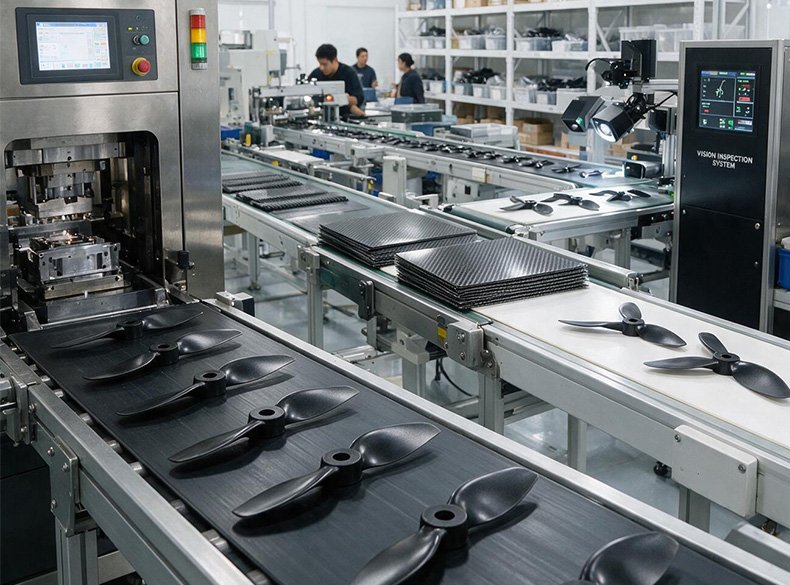
Unlike laminated composites that require multiple manufacturing steps, LFTs can be injection molded into highly engineered aerodynamic profiles.
Manufacturers can integrate:
• Reinforcing ribs
• Mounting features
• Hub interfaces
• Balancing structures
• within a single molded component.
• Faster Production
Injection molding offers:
• High repeatability
• Short production cycles
• Lower labor costs
• Consistent quality
This enables large-scale production of drone components without sacrificing performance.
Reduced Manufacturing Waste
Thermoplastic processing generates significantly less waste than many traditional composite manufacturing methods.
Additionally, production scrap can often be reprocessed, supporting lean manufacturing practices and improving material utilization.
Which Drone Applications Benefit Most?
LFT rotor blades are well suited for:
• Agricultural spraying drones
• Delivery drones
• Mapping and surveying UAVs
• Inspection drones
• Defense UAVs
• Emergency response drones
• Heavy-lift industrial drones
• Autonomous logistics platforms
As drone payloads increase, material efficiency becomes even more critical.

Can thermoplastics LFTs Replace CFRP/GFRP Carbon Fiber Rotor Blades?
CFRP and GFRP composites continue to offer the highest specific stiffness for certain premium aerospace and high-performance rotor blade applications. However, these materials also come with several manufacturing and cost challenges, including:
• Higher material and processing costs
• Longer production cycles due to curing time
• Additional post-molding operations
• More complex fabrication processes
• Limited recyclability compared with thermoplastic materials
For many commercial and industrial drone applications, thermoplastic LFTs may not replace CFRP or GFRP in every high-end use case, but they can provide a highly practical alternative where manufacturers need a strong balance of performance, cost efficiency, design flexibility, production scalability, and recyclability.
This makes LFTs particularly compelling for medium- to high-volume drone manufacturing where consistent quality and economical production are essential.
Sustainability: A Growing Competitive Advantage
The drone industry is increasingly embracing sustainable manufacturing practices.
Unlike thermoset composites, Long Fiber Thermoplastics can be reprocessed and mechanically recycled, helping reduce manufacturing waste and supporting circular material strategies. Their lightweight nature also contributes to lower energy consumption during operation.
Why Choose Skyi Long Fiber Thermoplastics?
Skyi develops advanced Long Fiber Thermoplastic materials using deep expertise in fiber-matrix chemistry, crystallinity, morphology, and rheology. With one of India’s largest LFT manufacturing capabilities, Skyi provides engineered materials designed for demanding structural applications requiring lightweight construction, durability, and high mechanical performance.
For drone manufacturers, Skyi’s LFT materials can enable:
• Lightweight rotor blades
• Structural drone arms
• UAV frames
• Motor mounting systems
• Landing gear
• Protective housings with EMI shielding
Delivering high performance with efficient, scalable manufacturing. Skyi already highlights drone arms and propeller blades among its composite application areas.
Conclusion
As drones become more capable, intelligent, and mission-critical, material innovation will increasingly determine competitive advantage.
Long Fiber Thermoplastics offer an ideal combination of lightweight performance, structural integrity, impact resistance, manufacturing efficiency, and sustainability—qualities that directly enhance rotor blade performance and overall UAV reliability.
For drone manufacturers looking to improve flight endurance, reduce production costs, and build next-generation aerial platforms, Long Fiber Thermoplastics represent more than an alternative material—they are a strategic engineering solution for the future of unmanned aviation.
Frequently Asked Questions (FAQs)
Can Long Fiber Thermoplastics be used for drone rotor blades?
Yes. LFTs provide an excellent combination of lightweight construction, high stiffness, fatigue resistance, and impact performance, making them suitable for many commercial and industrial drone rotor blade applications.
Which thermoplastics are commonly used in LFT rotor blades?
Polypropylene (PP), Polyamide (PA), PET, and PBT are commonly selected depending on the required mechanical properties, operating temperature, and environmental conditions.
Are LFT rotor blades recyclable?
Yes. Unlike thermoset composites, Long Fiber Thermoplastics can be mechanically recycled and reprocessed, supporting more sustainable manufacturing.
Why are LFTs better than short fiber composites for structural drone parts?
The longer reinforcing fibers provide improved load transfer, higher impact resistance, better fatigue life, and greater structural integrity, making LFTs suitable for demanding load-bearing applications.