
How we put more than 40% post-consumer recycled polypropylene into long glass fibre composites, and still met automotive interior specs.
Cradle to cradle sustainable solutions for automotive industry
The recycled-content clock is now ticking
In June 2026 the EU adopted its End-of-Life Vehicles Regulation (ELVR). For the first time, recycled plastic content in new cars is mandatory, not optional.
- 15% recycled plastic in newly type-approved vehicles six years after entry into force (around 2032).
- 25% recycled plastic after ten years (around 2036).
- At least 20% of that recycled content must come from end-of-life vehicles.
The rules also demand design for disassembly, extended producer responsibility and auditable material traceability (IMDS declarations, ISO 15343 verification). For OEMs and Tier-1 suppliers, recycled content is no longer a marketing line. It is a compliance number.
The hard part is structural and semi-structural parts. Recycled polymers are usually weaker, smell worse and vary from batch to batch. At Skyi Composites we set out to show that this trade-off can be engineered away.
Why recycled PP: the carbon math
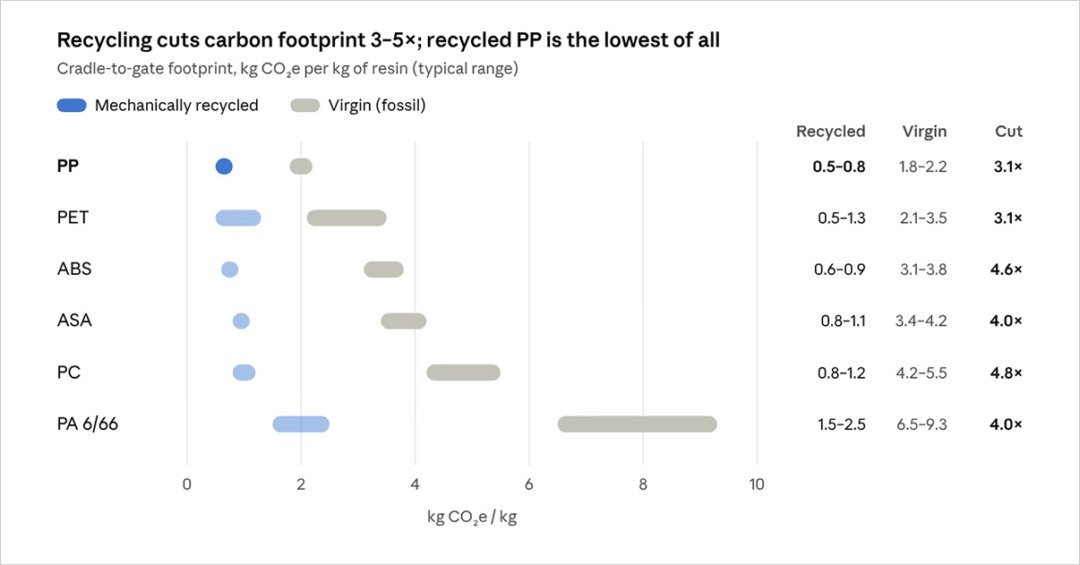
Over 85% of a plastic’s climate impact happens before it is ever used, during extraction, cracking and polymerisation. So the biggest lever is simple: stop making new polymer where recycled polymer will do. on the list. Recycled polypropylene is the least. That gap is why a PCR-PP long glass fibre compound that can replace glass-filled PA cuts CO₂-equivalent emissions by up to a factor of three, while also helping OEMs against carbon pricing such as the EU ETS and CBAM.
Polyamide, the usual choice for glass-filled structural parts, is the most carbon-intensive resin
How it works: clean the polymer, then coat every fibre
Our PCR-PP comes from mechanically recycled post-consumer waste such as battery casings, nets and handles. Mechanical recycling was a deliberate choice: it has the lowest CO₂e of the recycling routes.
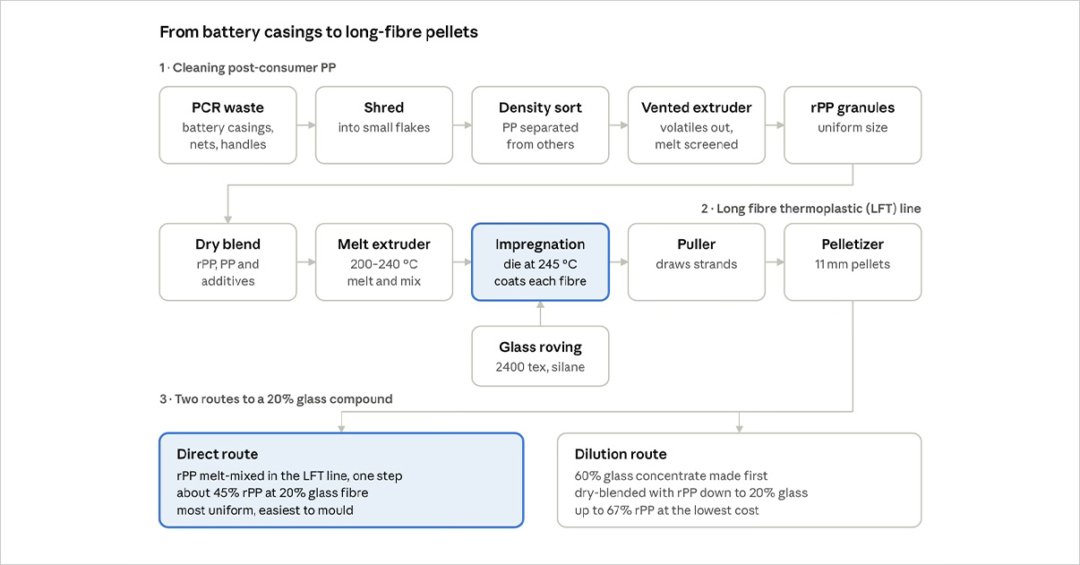
Recycled PP alone is not enough. Its chains are shorter, its melt viscosity drifts and it carries volatiles that cause odour and fogging. Our proprietary functional polymer additive fixes this during compounding. It raises melt viscosity and consistency, reacts with low-molecular-weight chains and helps strip volatiles, bringing the recycled resin back to near-virgin behaviour.
The heart of the line is Skyi’s melt-feeding manifold and impregnation die. Continuous glass roving is pulled through molten polymer so that each filament is wetted, not just the bundle. Pellets are chopped at about 11 mm, so the fibres stay 10–25 mm long in the moulded part. That fibre length is what gives LFT its strength, stiffness and impact resistance.
What the results show
We made 20% long glass fibre PP compounds with 40% to 67% recycled PP and benchmarked them against our 100% virgin grade, Stabil OH0135.
The virgin grade is still the strongest, but the gap is smaller than most engineers expect. Treei OH0135, made directly on the LFT line with more than 45% rPP, keeps 98% of the stiffness and loses about 16% in strength and 27% in impact. The 67% rPP grade maximises recycled content but gives up more impact (about 37%).
Lab coupons are one thing; a real part spec is another. In a case study on a passenger-car interior part, we tested strength and crash energy absorption from −30 °C to 80 °C.
Energy absorption tells the same story: every grade passed at every temperature, and absorption rose with temperature (for example 0.258 to 0.390 for Treei OH0135, 0.272 to 0.430 for the 67% grade). The recycled grades also meet VDA 270/271 limits for VOC emissions, fogging and odour, and match virgin compounds on long-term ageing and adhesion.
| If your priority is… | Choose | Why |
|---|---|---|
| Balance of performance and sustainability | Treei OH0135 (>45% rPP) | Best stiffness and impact among recycled grades; easiest to process |
| Maximum recycled content | RX_C24_304_01 (67% rPP) | Highest rPP; still passes the part spec |
| Lowest cost | RX_C24_304_02 (50% rPP) | Cheapest at about €1.58/kg; fine where impact is not critical |
Why this matters for circularity
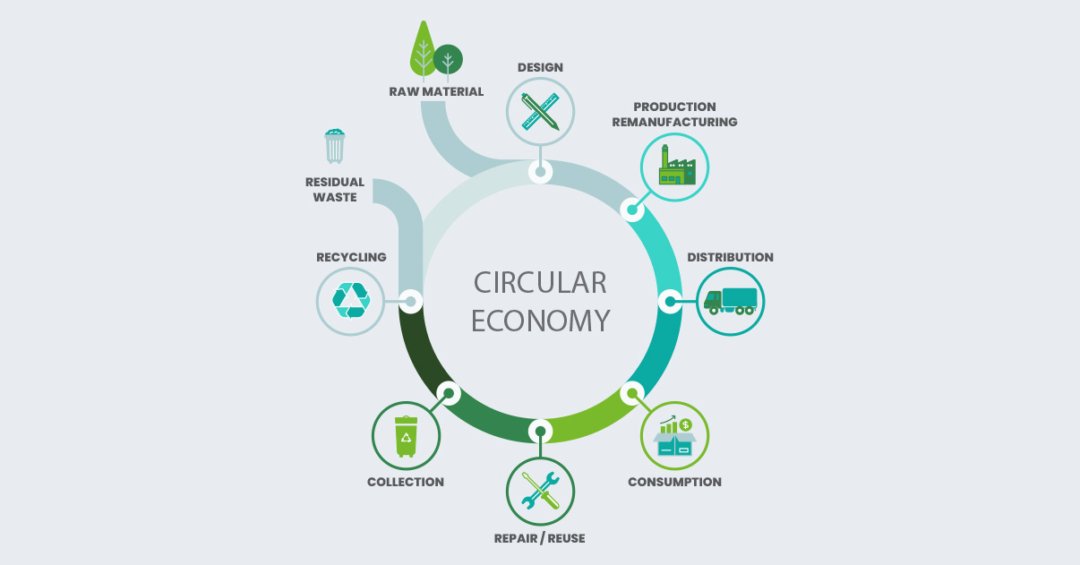
One compound now ticks three boxes at once: recycled content, lower carbon and a real automotive spec.
- Regulation-ready. A single part at 45–67% rPP moves the needle on the 15% and 25% ELVR targets far more than many low-content parts.
- Carbon. Replacing glass-filled PA with PCR-based glass-filled PP cuts CO₂e by up to three times, which matters as carbon pricing (EU ETS, CBAM) reaches supply chains.
- Recyclable again. PP-LGF is a thermoplastic, so the part can be reground and reprocessed at end of life, unlike thermoset composites.
- Competitive cost. The recycled grades price at about €1.58–1.60/kg, and the highest-rPP grade brings a small saving.
What we learned, and what's next
The biggest lesson: the process matters as much as the polymer. Long fibre melt impregnation tolerates recycled PP far better than short-fibre compounding, because the long glass network carries the load.
- Quality of the feedstock is everything. Sorting, venting and melt filtration upstream decide how much rPP the compound can take.
- Dilution gives the most rPP for the least money. A 60% glass concentrate made with virgin PP, then let down with rPP granules, reached 67% recycled content at the lowest cost.
- Direct is the most practical. For handling, transport, uniformity, moulding and long-term ageing, a direct PP-LGF 20% with about 45% PCR, melt-mixed on the LFT line, is the best all-round solution today.
- Impact is the property to watch. Grades with more rPP lose most on notched impact, so part design and grade choice should go together.
Next, we are working with OEM and Tier-1 partners to validate more interior and semi-structural parts, and to raise the share of recycled content that comes from end-of-life vehicles, as ELVR requires.
The takeaway
Recycled content and structural performance are no longer a trade-off you have to accept. With good feedstock, a functional additive and long fibre melt impregnation, a 20% long glass PP with 45% or more post-consumer recycled PP meets interior part specs, passes VDA 270/271 and cuts carbon by up to three times against glass-filled polyamide.
The ELVR clock has started. The materials are ready.
Are you specifying glass-filled PA or virgin PP-LGF for interior or semi-structural parts? Let’s talk about which of these grades fits your next programme.
Based on the paper “Recyclable thermoplastic composites based on PCR polymers” by Sachin Jain, Pooja Misal and Prasanna Godbole, Skyi Composites Pvt. Ltd., Pune.